The Disposable Palette

Tuesday, July 6, 2010

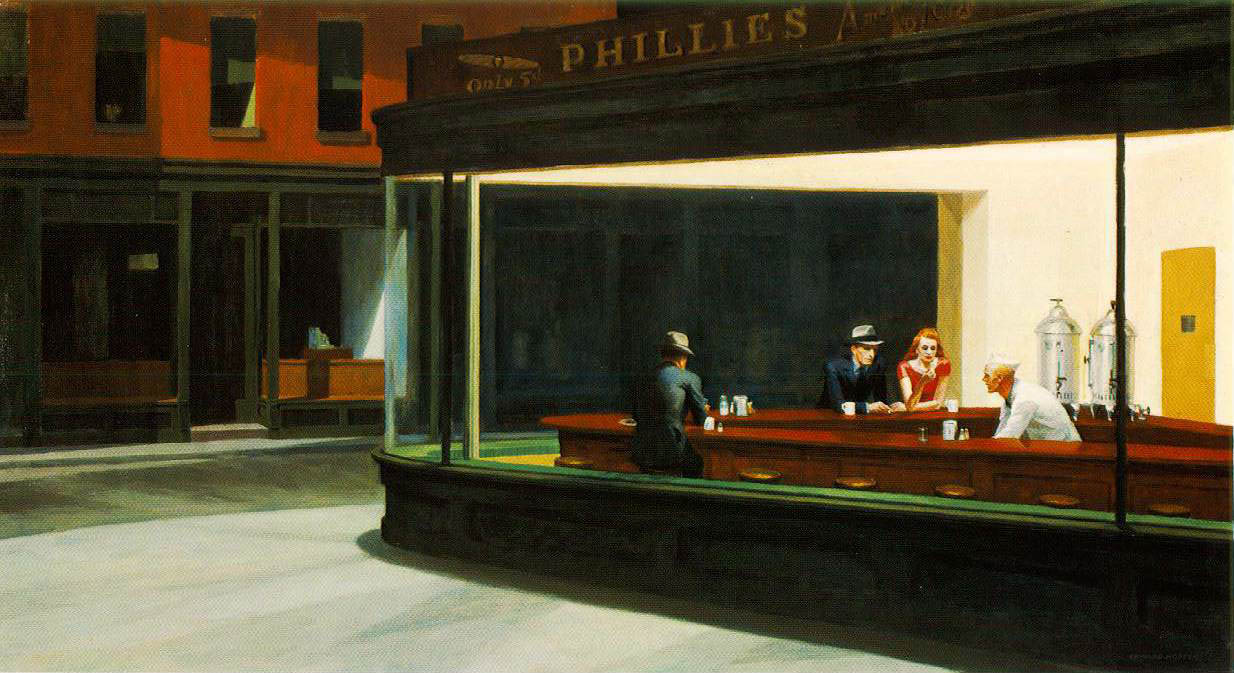
Nighthawks State of Mind


Jeremiah Moss
July 2, 2010
The New York Times

IN 1941, Edward Hopper began what would become his most recognizable work, one that has become an emblem of New York City. “‘Nighthawks,’” Hopper said in an interview later, “was suggested by a restaurant on Greenwich Avenue where two streets meet.” The location was pinpointed by a Hopper expert, Gail Levin, as the “empty triangular lot” where Greenwich meets 11th Street and Seventh Avenue, otherwise known as Mulry Square. This has become accepted city folklore. Greenwich Village tour guides point to the lot, now owned by the Metropolitan Transportation Authority, and tell visitors that Hopper’s diner stood there. But did it?

Not long ago, one of the readers of my blog, Vanishing New York, sent in an old photo of the lot. There was no diner, only an Esso gas station and a White Tower burger joint that looked nothing like the moody, curved, wedge-shaped lunch counter in “Nighthawks.” An urban mystery had just revealed itself: If the diner wasn’t in the empty lot, then where was it? Being an obsessive type, prone to delve, I began searching for Hopper’s diner with the help of two of my readers. Multiple streets converge at Mulry Square, creating a shattered-glass array of triangular corners. The buildings wedge themselves into these tight angles, bricks tapering to near points, each structure bearing a Hopperesque resemblance. I snapped photos of every possibility and checked them against their ancestral images in the New York Public Library’s Digital Gallery. I made a trip to the city’s Municipal Archives, where I scanned the 1930s atlases of Manhattan known as “land books,” matched block and lot numbers to scratchy rolls of microfilm and scrolled through muddy 1940s tax photos. Slowly, I began ruling out suspects. The empty lot at Mulry Square held a gas station from at least the ’30s through the ’70s, not a diner. I had to rule out the buildings on nearby corners of the square as well: West Village Florist was a newsstand. Fantasy World was a liquor store. Two Boots Pizza, with its lovely prow wrapped in rounded glass and chrome, was the Hanscom Bake Shop. And the pie-slice of a luncheonette that stood behind the lost Loew’s Sheridan cinema was too blocky, too brick-y to be the elegant diner in the painting.

So I expanded my search, looking at nearly every curvilinear corner where “two streets meet” off Greenwich Avenue. With each rejected candidate, my hopes of finding the “Nighthawks” diner fell. After hours of hunting the archives, I was about to give up when I found a new clue in a 1950s land book. There in the map of Mulry Square, not in the empty northern lot, but on the southwest side, where Perry Street slants, the mapmaker has written in all caps a single revelatory word: DINER. I went into a state of panicky thrill. Sometime between the late ’30s and the early ’50s, a new diner appeared near Mulry Square. This was it. I could smell the coffee brewing. After decoding the block and lot number, written in script so small it required a Sherlockian magnifying glass, after retrieving the microfilm spool and scrolling to the specified location, I discovered ... nothing. The tax photo showed only that old Esso station. I scrolled back and forth to be sure, but found no photo of the southwest corner, no photo of the diner in question. Did the tax photographers forget to take its picture? Did they mislabel the lot? It’s possible that I started muttering out loud to myself in the quiet of the Municipal Archives, because people began to stare.

Back home, I dug through my bookshelves and unearthed Gail Levin’s “Edward Hopper: An Intimate Biography.” The book is autographed by the author — I had gone to hear Ms. Levin read in a bookshop that is now gone — and dated from a time when I was still new to the city and knew it largely, romantically, as a sprawling Hopper painting filled with golden, melancholy light. In the book, Ms. Levin reported that an interviewer wrote that the diner was “based partly on an all-night coffee stand Hopper saw on Greenwich Avenue ... ‘only more so,’” and that Hopper himself said: “I simplified the scene a great deal and made the restaurant bigger. Unconsciously, probably, I was painting the loneliness of a large city.” Partly. More so. Simplified. The hidden truth became clearer. The diner began to fade. And then I saw it — on every triangular corner, in the candy shop’s cornice and the newsstand’s advertisement for 5-cent cigars, in the bakery’s curved window and the liquor store’s ghostly wedge, in the dark bricks that loom in the background of every Village street. Over the past years, I’ve watched bakeries, luncheonettes, cobbler shops and much more come tumbling down at an alarming rate, making space for condos and office towers. Now the discovery that the “Nighthawks” diner never existed, except as a collage inside Hopper’s imagination, feels like yet another terrible demolition, though no bricks have fallen. It seems the longer you live in New York, the more you love a city that has vanished. For those of us well versed in the art of loving what is lost, it’s an easy leap to missing something that was never really there.

Jeremiah Moss is the author of the blog Vanishing New York.

at Tuesday, July 06, 2010 No comments:
Labels: Edward Hopper

Thursday, March 25, 2010

Lucian Freud: the year I sat for the master

London Times, February 27, 2010

I am not entirely sure what prompted me to volunteer to be transformed into a work of art. I’d known Lucian Freud for some years — I still do. We’d had lunch and dinner numerous times, gone to jazz concerts together. But I think it was probably the traditional aim of the portrait sitter — self-assertion — that prompted me to volunteer myself very tentatively one afternoon a few years ago. I expected a non-committal response. He has, after all, a vast choice of potential models, including the Queen and Kate Moss — and I’m no supermodel. In fact he said: “How would you like to start next Tuesday evening?” And so it was that I stepped through the looking glass from writing about art to being transformed into a bit of it — in fact, two bits, an oil painting, Man with a Blue Scarf, and an etching, Portrait Head, a process that carried on for more than a year and a half. To paint, he wears a makeshift apron made out of rags that he leaves lying around the studio, like — as David Hockney observed when he sat for Freud, “a butcher”. This receives the bulk of the paint stains, but some spot his trousers and shirt. At times, with his sharp gaze, aquiline features and brushes protruding like quills from his palette, he looks a little like a gigantic bird. He mutters to himself quite often when working: “Slightly!”, “Quite!”, “No-o, I don’t think so”, and, on one occasion while examining the side of my head, “Hmm, it really does look like that. Well, I’ll use it!” One of the first things he said at the initial sitting was: “I may sound like an absolute lunatic.”
function slideshowPopUp(url)

Related Links
Freud's black eye self-portrait could fetch £4m
Millionaires queue for new Freud paintings

It was, as an experience, both marvellous and — or at least it seemed at the time — interminable. Freud is, of course, a painter now of immense renown. At 87 he has, more or less, become an old master in his lifetime (perhaps just about the last of the line). His Benefit Supervisor Sleeping holds the record, at £17 million, as the most expensive work by a living artist sold at auction, and he has had several successful exhibitions over the past few years in London, New York, Venice and elsewhere. Next month another major exhibition opens at the Pompidou Centre in Paris. The show is themed around the studio and features about 50 large-scale paintings that reveal the studio setting, as well as graphic works and photographs. The painter has not been exhibited in France since a retrospective in 1987 — “I am certainly pleased,” he told me last week. He long ago overcame the slight handicap of being descended from one of the most influential thinkers in Western culture — his grandfather Sigmund, of whom he was very fond — to earn international renown on his own account. In 1933, when the rising power of Nazism became threatening, his family emigrated from Germany to Britain. Since his teens Freud has pursued his own course, and by sheer talent and determination added a fresh chapter to a story that many in the art world believed was over: figurative painting from life.
Freud is, famously, a man who values his privacy. He has been interviewed on television only once in the past quarter of a century. By becoming a model, one enters into the most secluded of all areas — the one where the art is actually made. More, in a way — admittedly a humble one — you become a participant. Naturally, the artist does all the work, but the model is not a merely inert object. You are under observation — that’s the whole point of the exercise. And the more you reveal, by talking and behaving, the more material the artist has to use. That, at least, is the Lucian Freud method. This close scrutiny is a great deal more pleasurable than it might sound. The pleasure for me came from the always fascinating experience of watching the pictures grow, touch by touch, and also from the conversation that went on before, after and during the sittings.
Freud is not only an outstanding talker — witty, perceptive, with a mind unostentatiously stocked with memories and erudition — he also has the best, in fact probably the only, type of charm. That is, he is genuinely interested in the person to whom he is talking. That’s always the case, but the level of interest rises much higher when you are the subject of a picture. Then, for the duration of the sittings, you are enthralling to him: a mystery to be fathomed and transformed into paint. Of course, that intensity ends when the picture is finished, which I can imagine might be a bit of a shock for some sitters. In my case, a sense of deflation was almost exactly balanced by relief that it was finally over. After that, the picture left Britain. Bought by a private collector on the West Coast of America, it has been shown at the Correr Museum, Venice, and the Museum of Modern Art, New York, though sadly the picture’s lack of a studio setting means that it won’t be in the Pompidou show. One realises after a bit that the picture isn’t a reflection of the sitter: it’s an entity in its own right, with its own fate. “You’re here to help it,” as Freud put it. There were times, late on winter evenings, when it looked a lot more vigorous than I felt.
Freud’s subjects form a sort of Dickensian — or Balzacian — panorama of society. At one end of the social spectrum he has painted the late Duke and Dowager Duchess of Devonshire and Baron Thyssen. At the other, he has portrayed a number of burglars, neighbours of his in the days when he lived in Paddington, plus an acquaintance of the 1950s whom, he recalled, “lived in dustbins”. In between there have been sundry writers, painters, wives, friends, children, grandchildren, lovers, restaurateurs, fashion models — including Moss and Jerry Hall — a jockey, several bookmakers, the now-celebrated benefit supervisor and the performance artist Leigh Bowery. What all these heterogeneous people have in common is that they interest Freud visually and as personalities. Most sitters, including celebrated ones, are reduced to anonymity in his titles (he sometimes makes an exception, especially for artist friends such as Frank Auerbach and Francis Bacon). Some he pays, some not: I preferred to keep it on a basis of friendship. The other requirements are temperamental congeniality — after all, he is going to spend months if not years in the model’s company — and punctuality. Models who do not turn up at the appointed hour are among his greatest bugbears.
For the oil I would arrive at about 6pm and Freud, who might already have worked on two other pictures that day, revved himself up to work while we chatted and drank — usually tea for him, sometimes claret for me. Then we would go upstairs to the studio, a perfect Georgian room with bare boards and some walls encrusted with paint-scrapings forming an accidental abstract design. Other pictures were going on at the same time — a full-length portrait of Andrew Parker Bowles in military uniform, a couple of nudes. The sitters for these were like invisible colleagues. Freud would tell me a lot about them, and vice versa as it turned out. When I finally met Parker Bowles he began, disconcertingly, with the words, “I’ve heard a lot about you!” Once in the studio the work would begin. It is, as far as Freud is concerned, a gruelling business, which depends on his energy (which is considerable). Light and lean, he stands up to paint, or rather constantly moves about: back to examine what he has just done, or forward to add a touch of paint or peer at me, a bit like an explorer confronting a new bit of jungle. One evening, he suddenly asked me where he could get a set of scales. “When you work on your feet even an extra pound or two makes a difference.” I suggested John Lewis. Freud paints and etches very slowly, and once a picture is begun it must continue in precisely the same circumstances, in my case sitting in a chair with my head at a certain angle, about which he was extremely particular. “Could you turn your chin a little to the right?” he might say, dozens of times an evening. “No, that’s too much. Now that’s very good.” Posing is both strangely intimate and overpoweringly relaxing — a combination of a visit to the barber’s and transcendental meditation. There were moments when we got as far as my clothes — Freud tends to work outwards from a central point, in my case a spot in the middle of my forehead — and then he would apologetically rearrange the folds for me.
One realises that this slow, deliberative pace is crucial to the quality of the results. A great deal of his time is spent not painting but thinking: mixing the precise shade and tone for each stroke of the brush, considering the strategy of the next mark in advance, pondering the result afterwards. One day my upper lip appeared, in an unexpected shade. “You’ve given me a moustache,” I observed. “Yes,” he replied with satisfaction, “it’s a lovely green colour.” Eventually, when the patchwork of brushstrokes was complete, it fitted in perfectly. After half a year, I remarked that I might have changed since the beginning — my hair was probably greyer, for instance. “Oh, have we been working for six months?” he replied, mildly surprised. “It seems like five minutes.” We talked about everything from Goya and Rembrandt to what was in the day’s newspaper. Freud, who is fond of poetry, quoted from memory works by Larkin and Byron, and recited several of Hilaire Belloc’s Cautionary Tales. One afternoon he gave a creditable rendition of a calypso he heard on a voyage to the Caribbean in the early 1950s: “Well it was love, love alone/Caused King Edward to leave his throne.” A subject that came up quite often was Freud’s times in Paris in the 1940s and 1950s, and we spoke again about this when I visited him last week. “When I was very young,” he recalls now, “just the mention of Paris was the most exciting thing. Everything there sounded marvellous.” It was then the undisputed world capital of art, still inhabited by great artists such as Picasso. “I spent a lot of my time in the Deux Magots [the celebrated literary and artistic café]. I had no money, so I used to wait for someone to buy me a drink. I was staying in a hotel very near there. Giacometti went there a lot after he had finished work and I would meet him.” In Jamaica, he stayed with Ian Fleming, who told him that the character of James Bond was partly based on him. “I thought that was a strange idea — but I got into fights, which was more than he did. There was a period when I used to feel it was easier to hit somebody often than to have a conversation.” (Proof of that remark recently emerged, in a previously unknown SelfPortrait with a Black Eye.) One thing that you learn from sitting is that, effectively, inside the studio you are in an eternal present. Attention is always on the painting of the moment, and on the next brushstroke. That is one of the aspects of sitting that makes it strangely therapeutic, even addictive. There is nothing required of the sitter except punctuality, and, once placed in the required pose, simply to be. Although it is true that, after a while, you begin to wonder how long it will last.
As far as Freud is concerned, a picture takes as long as it takes to finish (sometimes years). The only concern is whether it is really and truly finished, and when it is — then on to the next one. So painting — looking, thinking, making a mark — is how he has spent by far the largest proportion of the past seven decades. To him, it is scarcely work, but “what most interests and entertains me”. He has no secret, he remarked once, except concentration, “and that can’t be taught”. Freud’s work in fact now represents one of the marathon feats of concentration — on his subjects and their individuality and on the language of paint and forms — in the whole history of Western art.

Martin Gayford’s book Man in a Blue Scarf: On Sitting for a Portrait by Lucian Freud will be published in September (Thames & Hudson). Lucian Freud is at the Centre Pompidou, Paris (centrepompidou.fr, 01 44 78 12 33), March 10 to July 19
at Thursday, March 25, 2010 No comments:
Labels: Lucian Freud

Wednesday, September 2, 2009

Alice Neel Documentary from artnewyork.org

at Wednesday, September 02, 2009 No comments:
Labels: Alice Neel

Alice Neel Documentary

at Wednesday, September 02, 2009 No comments:
Labels: Alice Neel

Edouard Vuillard. Old Woman in Interior/La vielle femme dans un intérieur. c. 1893


at Wednesday, September 02, 2009 No comments:
Labels: Edouard Vuillard

Alice Neel, The Last Sickness, 1953


at Wednesday, September 02, 2009 No comments:
Labels: Alice Neel

Alice Neel: Portrait of a Lady

Nina P. West
Forbes 09.17.07


Alice Neel, a 20th-century American painter from Spanish Harlem, turned out to be the breakout star of Christie's recent contemporary art auction. Andy Warhol and Jean Michel Basquiat usually grab the headlines at superstar-focused auctions, but savvy insiders were paying special attention to Alice Neel's portrait, "Roberta Johnson Roensch." They predicted it would take off. They were right. The portrait of a wide-eyed young bride sold for nearly half a million dollars at Christie's Sept. 10 auction of Post War and Contemporary Art. The painting, on the auction block for the first time since it was created in the '40s, sold to a private U.S. collector after strong bidding for $445,000. It was expected to fetch between $50,000 and $70,000. It also set a new record for any Alice Neel painting at auction. The previous record, for the portrait "Peter B. Kaplan" was $216,000, sold at Sotheby's in 2006. Alice Neel worked in relative obscurity most of her adult life. She lived in Spanish Harlem, where her friends and neighbors became the subjects of her portraits. Her art often reflected her personal life, which was complicated and at times tragic. Says her eldest son, Richard Neel, "We always had this dream that she would be recognized and she would be able to get some money from her work. It really did not work out that way when we were children." Late in her life, she did gain some broad recognition, but nothing like the applause her works receive today.
Artfact Analysis:
Why has it taken the auction market so long to accept Alice Neel into the contemporary art "major leagues?" Lack of exposure at auction may be one factor. Ms. Neel had a lover who slashed 60 of her paintings and burned 300 of her drawings. The market can hardly support an artist with relatively few works to sell. Her works also lack easy definition. Collectors of American Art don't consider Alice Neel part of the Ash Can School or the American Modernist School, and the glitzy works by Abstract Expressionists attract the Post-War collectors. Ms. Neel's paintings are simply off the radar of most collectors. The record-breaking price for the portrait "Roberta Johnson Roensch" does not change the entire market for her work. Use caution when assuming that all Alice Neel paintings have suddenly quadrupled in value. For many years, the average price at auction for a Neel portrait has hovered around $50,000. The art market is finally catching up to what scholars and museums have known for years, but, like so many artists, the quality of Ms. Neel's work can be uneven, so choose wisely.
For a larger perspective on Alice Neel, read the 374-page biography by art historian Pamela Allara entitled Pictures of People: Alice Neel's American Portrait Gallery. The 2007 film Documentary Alice Neel by her grandson Andrew Neel is also a wonderful personal study of the artist's life. For Alice Neel auction records over the past 15 years, consult Artfact.com for art and antiques with over 20 million auction results.
at Wednesday, September 02, 2009 No comments:
Labels: Alice Neel

Amedeo Modigliani, Head of a young woman, 1908


at Wednesday, September 02, 2009 No comments:
Labels: Amedeo Modigliani

Alice Neel, Portrait of Ben Medary, 1930


at Wednesday, September 02, 2009 No comments:
Labels: Alice Neel

Tuesday, September 1, 2009

Paint, Easel, Bug Spray, Gun . . .

Artists find that working outdoors can be a struggle against natureArticle Comments (11) Email

By DANIEL GRANT
Wall Street Journal
August 28, 2009

The 19th century was the great age of plein-air landscape painting, when artists left their studios and took to the outdoors to capture not a romanticized ­vision of nature but the real thing. To help along the process, easels became more portable and paints were fit into small, squeezable tubes. However, other technical problems were not so easily overcome, such as the wind that could blow dirt onto a canvas or the canvas off the easel. The glare of the sun, rain and snow, biting insects or worrisome wild animals, as well as interruptions caused by fellow humans, all add to making what should seem like a delightful experience—drawing or painting in the fresh air—into a battle of wills. The struggle proved too much for Nancy Howe of East Dorset, Vt., a current member of the Society of Animal Artists, who used to bring her art supplies outside but now takes only a camera to capture forms and a sketchbook to ­record color values. "I can't get comfortable outside, and I get too distracted," she said. "Even if I have bug stuff on me, I can still see flies buzzing around me. I can't work like that."

Perhaps cameras should be included in portable paint sets, since so many wildlife and plein-air artists rely on their photographs to capture the out-of-doors back in their studios. For that matter, one might include guns and flatbed trucks as plein-air accouterments, since a number of artists use one or the other (sometimes, both) when they set out to paint. John Seerey-Lester of Osprey, Fla., and Linda Tippetts of Augusta, Mont., both painters, bring ­revolvers along for protection—he (primarily) from animals, since he is a wildlife artist, and she from people who might bother her. "I've been in places where I put my pistol on the ­easel," she said. "I've never had to use it, but I want people to see it's there." Another artist, Walt Gonske of Taos, N.M., carries a mace gun, which he also has never used, but he has known human-caused danger. "Once, I had a beer can thrown at me from a car going 50 miles an hour," he said.

Dangers of painting outdoors can be quite real. In 1996, painter Stephen Lyman hiked into Yosemite National Park and fell, dying of exposure; and wildlife artist Simon Combes was killed by a charging cape buffalo while walking in Kenya in late 2004. Framingham, Mass., painter Ben Aronson had a shotgun aimed at him by a farmer on whose land he had been trespassing ("I was in a field where there was nothing to steal, but I was clearly an oddity"). Asking permission before going on private property is always a good idea. So is not provoking animals. "I threw stones at an elephant to get good photographs of an angry elephant," said Bernardsville, N.J., wildlife artist Guy Coheleach. "That was a stupid thing to do. I got a better sense of what a terrified artist looks like." And Ken Auster, a plein-air painter who lives in ­Laguna Beach, Calif., learned the hard way that purchasing a tides book made sense after he got caught on a beach between two rocky points when the tide was coming in and there was no way to get out other than to swim—he had to hold his easel, paint box and canvas above the water for several hours until the tide went back out.

With many years of painting on beaches under his belt, Mr. Auster cautioned against using large canvases outdoors ("the wind blows them like a sail"), wearing flip-flops ("they kick sand up at the paintings as you walk"), and trying to pick off grains of sand that have been blown on the canvas by the wind: "Don't touch it," he said. "Just wait till it dries and the sand will fall off on its own." Artists are by nature problem-solvers, and painters who work outdoors find that they need to come up with a variety of creative solutions to the difficulties they face. Attaching an umbrella to an easel may block rain and sun, although a gust of wind once filled up Linda Tippetts' umbrella like a sail, carrying her easel into a ravine. Santa Barbara, Calif. pastel artist Glenna Hartmann has used her umbrella largely to scare away mules and horses ("the noise and action of flipping it open and closed a few times disconcerts them").

The travails of painting outdoors, while frequently discussed among plein-air artists, are never mentioned in histories of landscape painting, nor have great artists described these problems in their diaries or correspondence. One might imagine Claude Monet, standing outside and painting picture after picture of the same French haystacks, swatting the flies he ­undoubtedly attracted, but he apparently never brought up the subject in letters. Vincent van Gogh complained about everything under the sun in letters to his brother, but mosquitoes never entered into the ­correspondence. Mr. Aronson, on the other hand, recalled at length his ­experience being crop-dusted while painting in a wheat field ("the painting was destroyed, needless to say"), the day after being chased out of a different field by a bull and the day before setting up his easel on a red ant hill ("I did quite a dance when I saw what was coming up my leg").

But perhaps the oddest sight of all is Jamie Wyeth, who kneels inside a four-foot high, seven-foot long, three-sided wooden bait box when he goes outside to paint on Monhegan Island, Maine. (He puts a heater in during cold weather.) "My box is mainly for privacy," he said, noting that "I find it extremely bothersome when people talk to me while I'm painting. If I don't say anything to them when they ask a question, or if I tell them I don't like to talk while I'm working, then I feel terrible that I've been rude. Inside the box, people see that I clearly don't want to talk, and they eventually scurry away."

—Mr. Grant is the author of "The Business of Being an Artist" (Allworth).
at Tuesday, September 01, 2009 No comments:
Labels: Plein air

Tuesday, May 5, 2009

Hallado en un domicilio particular danés un busto realizado por Paul Gauguin

El busto de un niño realizado por Paul Gauguin en 1881, de cuya existencia no se tenía noticia, ha sido descubierto en la casa de una familia danesa. La obra se presentará hoy en el museo Ordrupgaard, cerca de Copenhague, en una muestra sobre el pintor. Los Avnsoe, propietarios de la pieza, no sabían nada sobre ella. La heredaron y la usaban como adorno en Navidad. Un tasador visitó a la familia después de que robaran en la casa y al ver la pieza les recomendó que fueran a un anticuario. Los propietarios han vendido el busto al museo Ordrupgaard por 25.000 euros. Los expertos dicen que Gauguin lo modeló en París en 1881, con su hijo Jean de modelo.
Aseguran que Paul Gauguin se lo llevó a Dinamarca en 1884 cuando se mudó allí con su esposa danesa, Mette Gad, y sus cinco hijos. "Heredé este busto y nunca había creído que fuera auténtico, aunque lleva inscrito el nombre de Gauguin", dijo Bent Avnsoe.
El Pais, 31 de Agosto del 2005
at Tuesday, May 05, 2009 No comments:
Labels: Gaugin

Monday, May 4, 2009

Alice Neel, Abdul Rahman (1964)


See this portrait at the Victoria Miro Gallery
at Monday, May 04, 2009 No comments:
Labels: Alice Neel
Newer Posts Older Posts Home
Subscribe to: Posts (Atom)

Color Theory

  • Color Matters
  • Color Mixing
  • Philosophy of Color
  • WORQX

Composition & Design

  • Basics of Landscape Composition
  • Murals in the Smithsonian American Art Collection
  • Visual Composing, Dianne Mize

Art Technique

  • How Van Gogh made his mark
  • Mixing tips
  • Mosaics by Artaic

Art Equipment

  • Art Boards
  • Brush Strokes
  • Dick Blick

Artists of Reknown

  • Alice Neel
  • Artists at the Met
  • Carl Schmitt
  • Childe Hassam
  • Childe Hassam
  • Claude Monet
  • Edgar Degas
  • Edvard Munch
  • Edvard Munch
  • Henri Matisse
  • Joaquin Sorolla
  • Louis Valtat
  • Mary Cassat
  • Paul Cezanne
  • Paul Cezanne
  • Raoul Dufy
  • Vincent Van Gogh
  • Web Museum List of Artists

Art History

  • Archive of Painting, Sculpture & Architecture, Professor Jeffrey Howe, Boston College
  • Art Cyclopedia
  • Art History
  • Art History Resources
  • Art Renewal Center
  • ArtChive
  • Ask Art
  • Cape Cod School of Art
  • Cuban Artists
  • Fauvism
  • German Expressionism
  • OCAIW Catalog
  • Olga's Gallery
  • Renoir's "Boating Party": The Story behind the Masterpiece
  • The Athenaeum
  • Timeline of Art History, Metropolitan Museum

Art Societies & Events

  • Art Net
  • En Plein Air Masters, California
  • Giverny and the Impressionists
  • International Plein Air Painters
  • Oil Painters of America
  • Plein Air Georgia
  • Plein Air Painters of America
  • Russian Art Gallery
  • Sonoma Plein Air

Art Critics & Commentary

  • Art City, Mary Louise Schumacher

Science, Technology & Forensics

  • Parma Conservation
  • Art Watch
  • Art Forensics Site

Museums

  • Art Museums Worldwide
  • Barnes Foundation
  • Catalog of Collections in French Musuems
  • Detroit Institute of Arts
  • Guggenheim
  • Metropolitan Museum of Art
  • MOMA
  • Musee d'Orsay
  • Museo Thyssen-Bornemisza
  • National Academy of Fine Arts, New York, NY
  • National Gallery of Art, USA
  • National Portrait Gallery, UK
  • National Portrait Gallery, USA
  • Pennsylvania Academy of Fine Arts
  • Royal Museums of Fine Arts of Belgium
  • Royal Museums of Fine Arts of Belgium
  • Smithsonian Encyclopedia of Art & Design
  • The British Museum
  • The British Museum Images
  • The Hermitage, Saint Petersburg
  • The Louvre
  • The Phillips Collection
  • Van Gogh Museum, Amsterdam

Artist Blogs & Homepages

  • Alla Prima
  • Jennifer Young
  • L. Diane Johnson
  • Lois Griffel
  • My French Easel

Blog Archive

  • May (1)
  • August (4)
  • July (1)
  • February (1)
  • October (1)
  • September (1)
  • October (1)
  • July (4)
  • March (1)
  • September (8)
  • May (6)
  • April (3)
  • February (2)
  • January (5)
  • October (2)
  • September (8)
  • August (42)

Demonstrations

  • Demonstration of still life in pastel by L. Diane Johnson
  • How to paint a glass, Alexei Antonov
  • How to paint a rose, Alexei Antonov
  • How to paint an apple, Alexei Antonov
  • Landscape demonstration, Jennifer Young
  • Plein aire demonstration by L. Diane Johnson

Art Instruction & Advice

  • Art Instruction, Nancy Doyle
  • Empty Easel
  • Oil Painting Lessons, Bill Martin
  • Oil Painting Techniques
  • The Painter's Keys
Awesome Inc. theme. Powered by Blogger.